Thinking about the Lifecourse by Elizabeth Frost Stuart McClean
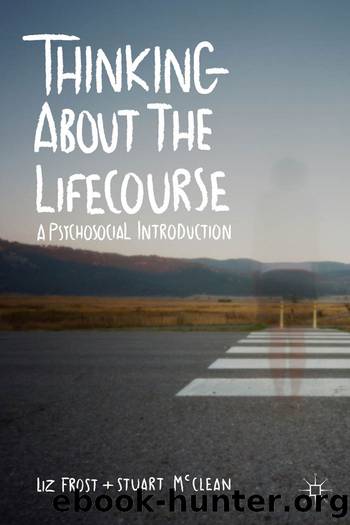
Author:Elizabeth Frost, Stuart McClean [Elizabeth Frost, Stuart McClean]
Language: eng
Format: epub
Tags: Political Science, Public Policy, Social Services & Welfare, Social Science, General, Reference, Social Work
ISBN: 9781137400581
Google: w_j7AwAAQBAJ
Publisher: Macmillan International Higher Education
Published: 2013-11-25T02:37:51+00:00
Philosophical roots of approaches to well-being
On one level there are, we would argue, well-established links between well-being, satisfaction, contentment and happiness; that is to say, in the context of an individualâs growth and development, how well oneâs life is going in a subjective sense. The late eighteenth/early nineteenth-century philosopher Jeremy Bentham put forward the classic utilitarian view that happiness was the balance between the good and bad things happening in oneâs life, or rather the greatest happiness for the greatest number. Increasingly, as we shall see, in positive psychology (see Box 6.1) and popular self-help books that proliferate in bookshops and libraries in the UK there is an interest in helping one to evaluate the role of happiness (or, âdoing wellâ) in oneâs life (and how to achieve it of course) and the relative notion of well-being.
In this way, well-being is a useful term that can be deployed instead of terms like mental health, as well as happiness, for it is about the individualâs whole life â well-being can also be said to contain a âholisticâ message about the nature of individual and social health and fulfilment. Thus, it is a term that aims to give us a more holistic and broader understanding of someoneâs total health and happiness situation. For that reason alone it can prove to be a more useful term to help us understand the psychosocial dimensions of doing well, as it seeks to get beneath the surface to understand how internal psychic dynamics operate in a social context.
Furthermore, what this utilitarian idea (from Bentham) also tells us is that most popular psychology theories and ways of thinking about well-being take into account the hedonic view of doing well and happiness, that is, the view that oneâs purpose is to maximize pleasure and minimize pain and misery â this is in the dominant, ordinary sense of the term that happiness is suggestive of ebullience or joie de vivre. Many individuals strive for things and material pleasures that may give them a form of happiness; and thus frustration and strain can arise when these cannot be achieved (see Merton in Chapter 7 for a discussion of the implications of this for ill-being). For this approach âhedonicâ well-being is the raising of subjective levels of happiness (Carlisle et al., 2009) and having access to as many âpleasuresâ as possible, however they are defined.
Other approaches can be summarized by the eudemonic approach to well-being, which the early Greek philosopher Aristotle put forward to argue that not all pleasures are equal in terms of providing well-being. Here, well-being is not solely about subjective happiness. Moreover, human striving, suffering, effort and engagement in the pursuit of something in itself can be worthwhile and provide well-being (pleasure and happiness may therefore be one particular outcome) as well as leading to the realization of human potential (Ryan and Deci, 2001). Pleasure in this sense may not be the only outcome, and it is not uniformly good for people; indeed, in a collective sense oneâs
Download
This site does not store any files on its server. We only index and link to content provided by other sites. Please contact the content providers to delete copyright contents if any and email us, we'll remove relevant links or contents immediately.
| Anthropology | Archaeology |
| Philosophy | Politics & Government |
| Social Sciences | Sociology |
| Women's Studies |
Cecilia; Or, Memoirs of an Heiress — Volume 1 by Fanny Burney(32573)
The Great Music City by Andrea Baker(32038)
Cecilia; Or, Memoirs of an Heiress — Volume 2 by Fanny Burney(31969)
Cecilia; Or, Memoirs of an Heiress — Volume 3 by Fanny Burney(31949)
We're Going to Need More Wine by Gabrielle Union(19062)
All the Missing Girls by Megan Miranda(16081)
Pimp by Iceberg Slim(14543)
For the Love of Europe by Rick Steves(14236)
Bombshells: Glamour Girls of a Lifetime by Sullivan Steve(14091)
Talking to Strangers by Malcolm Gladwell(13394)
Norse Mythology by Gaiman Neil(13387)
Fifty Shades Freed by E L James(13252)
Mindhunter: Inside the FBI's Elite Serial Crime Unit by John E. Douglas & Mark Olshaker(9359)
Crazy Rich Asians by Kevin Kwan(9304)
The Lost Art of Listening by Michael P. Nichols(7516)
Enlightenment Now: The Case for Reason, Science, Humanism, and Progress by Steven Pinker(7321)
The Four Agreements by Don Miguel Ruiz(6772)
Bad Blood by John Carreyrou(6629)
Weapons of Math Destruction by Cathy O'Neil(6292)
